

I did not want to write this issue. 11 Houses is about a cheap stone house with a lemon tree, not about where to hide. But the replies to the Greece guide, to the security issue last October and to the climate-safe issue all circled the same question, phrased ten different ways: if things go badly, where would I want to already own a place?
Every attempt I have seen to answer that question makes the same mistake. It produces one list. “The ten safest countries.” As if a Russian tank column, a warhead, a forty-degree August and a bank run were the same thing and hit the same places. They are not, and they do not. Estonia is one of the best-run countries in Europe and would be the first to burn in one specific war. Britain is an island with no earthquakes and superb institutions and is also a nuclear power, which makes it a target in exactly one scenario. Southern Spain is peaceful, cheap, open to anyone and on a trajectory towards semi-desert by 2050.
So this issue does not have one map. It has four, plus a composite that combines them with weights I state openly so you can disagree with them. And it applies one filter that none of the “safest country” lists ever apply: can a normal foreigner legally buy a house there and obtain the right to live in it? That filter removes half the top tier. Keep reading.
Why now
The Institute for Economics & Peace counted 59 active state-based conflicts in its 2025 Global Peace Index, the most since the end of the Second World War. The economic cost of violence reached 19.97 trillion dollars in 2024, 11.6 percent of global GDP. Every nuclear-armed state has maintained or expanded its arsenal since 2022.
In the same three years the safest countries on earth have been closing their doors to foreign buyers. Canada’s ban on non-Canadians buying homes in its metropolitan areas runs to January 2027. Australia banned foreigners from buying established homes until 2029. New Zealand’s ban stands for anyone without a five-million-dollar investor visa. Spain, Ireland and Portugal all shut their real-estate golden visas.
The places you would want a Plan B are the places making a Plan B hardest. That is the tension this issue is about.
Four scenarios
Before you read any map, decide what you are actually afraid of. The four scenarios below cover most of what readers wrote to me about. They are not equally likely, and I weight them accordingly, but they are different in kind, and a house that protects you against one can expose you to another.
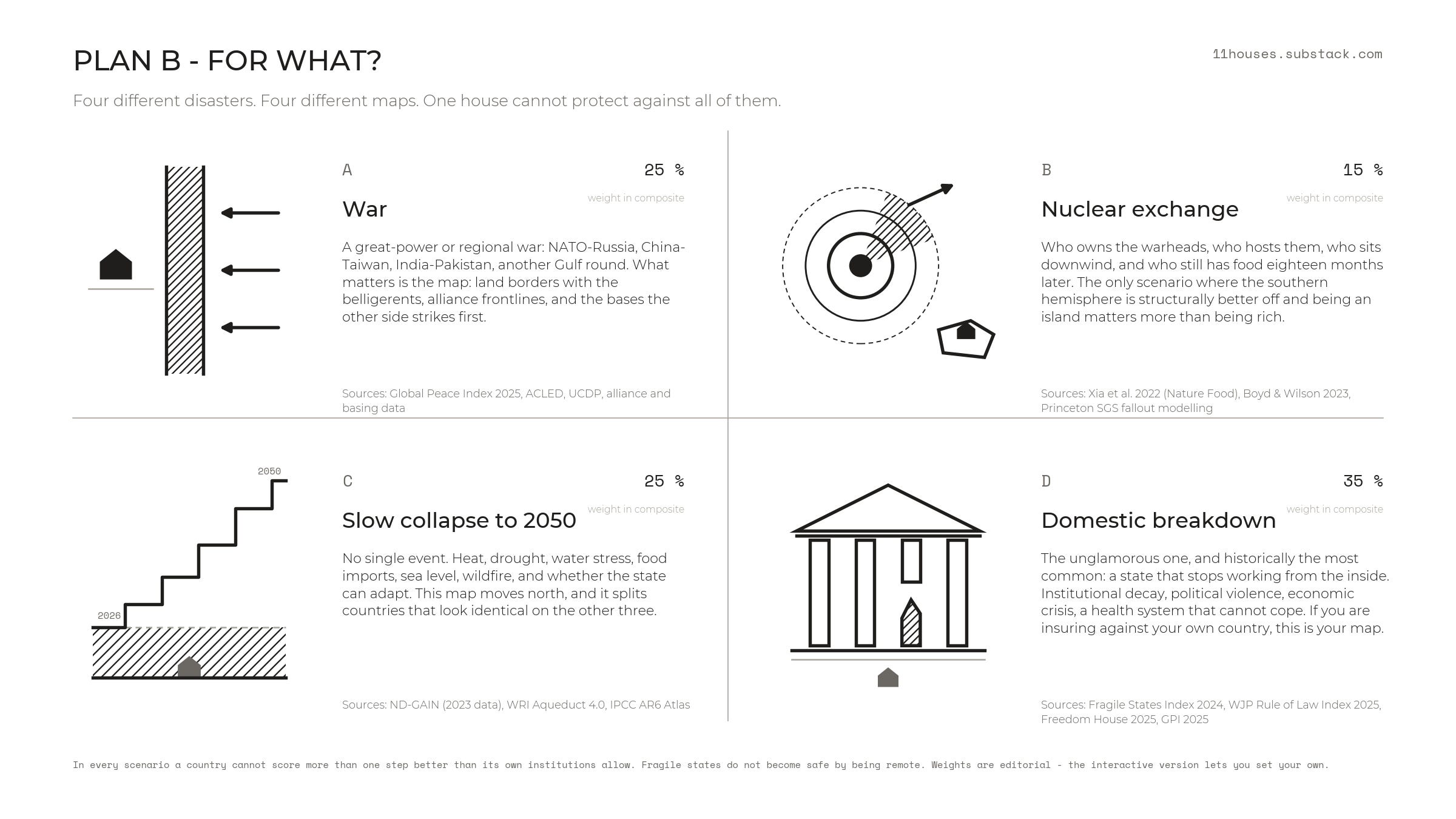
A. War. A great-power or regional war - NATO-Russia in the Baltic and Nordic theatre, China-Taiwan, India-Pakistan, another Gulf round. What matters here is geography and alliances: land borders with the belligerents, membership of the alliance frontline, hosting the bases and command nodes the other side would strike first.
B. Nuclear exchange. Who owns the warheads, who hosts them, who sits downwind, and - the part almost nobody scores - who still has food eighteen months later. This is the only scenario where the southern hemisphere is structurally better off, and the only one where being an island matters more than being rich.
C. Slow collapse to 2050. No single event. Heat, drought, water stress, food import dependence, sea level, wildfire, and the ability of the state to adapt. This map moves north, and it splits countries that look identical on the other three.
D. Domestic breakdown. The unglamorous one, and historically the most common: a state that stops working from the inside. Institutional decay, political violence, economic crisis, a health system that cannot cope. If you are buying a Plan B against the country you live in rather than against a foreign army, this is your map.
How the scoring works
Eight public indices feed the model. I did not invent any numbers; where a source does not cover a country the country is marked missing, not guessed. The exact rules are below because a ranking you cannot audit is an opinion with a colour scheme.
Institutional baseline (this is scenario D). Every country gets a baseline from the Fragile States Index 2024, the Global Peace Index 2025, the WJP Rule of Law Index 2025 and Freedom House. Band 1: fragility score under 30, or under 45 combined with a top-30 peace ranking, and rated Free. Band 2: fragility 30-60, or a strong state that is not a free democracy. Band 3: fragility 60-90 (”Warning”). Band 4: fragility above 90 (”Alert”) or active state failure.
War exposure (scenario A)
Level 4: active war on your territory or party to hostilities in 2025-26.
Level 3: a land border with Russia, Belarus, Ukraine or an active war zone; an unresolved flashpoint with a nuclear-armed state (Taiwan, the Koreas, Kashmir, Bhutan’s Himalayan border); or a Gulf state hosting US bases inside Iranian missile range.
Level 2: owning or hosting nuclear weapons; NATO eastern flank without a direct border; hosting a major US or NATO strategic node in a contested theatre; a border with a state that has an unresolved secession dispute (which is why Croatia, with a thousand kilometres of Bosnian border and Republika Srpska talking openly about leaving, is not in the top tier).
Level 1: none of the above.
Nuclear exposure (scenario B)
Level 4: the nine nuclear-armed states.
Level 3: countries hosting warheads (Germany, Belgium, the Netherlands, Italy, Turkey under NATO sharing; Belarus under Russian deployment since 2023), plus Japan and South Korea for the density of US strategic presence, Canada for NORAD and the fallout that Princeton’s modelling drifts across the Prairies from the American silo fields, and Iran as a struck nuclear-programme target.
Level 2: the default for everyone else in the northern hemisphere, which loses most of its harvest in the Xia et al. nuclear-winter model regardless of where the bombs fall.
Level 1: the five island nations Boyd and Wilson identify as refuges - Australia, New Zealand, Iceland, Solomon Islands, Vanuatu. Southern-hemisphere food exporters such as Argentina, Uruguay and Paraguay stay at level 2: Xia et al. find the smallest crop losses in the southern hemisphere, but no peer-reviewed study puts them on a refuge list, so I do not either.
Climate exposure (scenario C). From ND-GAIN (June 2025 release, underlying data 2023), WRI Aqueduct 4.0 projections to 2050 and the IPCC AR6 regional atlas. Level 1: high latitude, water-rich, food exporter. Level 2: manageable increase in heat and drought with strong adaptation capacity, or a temperate southern country. Level 3: high projected water stress by 2050 in WRI Aqueduct, Mediterranean or subtropical heat, or serious sea-level and cyclone exposure. Level 4: the Middle East, the Sahel, South Asia, the great deltas.
One rule ties them together. In scenarios A, B and C a country cannot score more than one step better than its own institutions allow. Paraguay is far from every war, but a state with a rule-of-law ranking of 100th out of 143 is not a low-risk place to sit one out. Fragile states do not become safe by being remote.
The composite weights the four scenarios 25 / 15 / 25 / 35 - war, nuclear, 2050, domestic. Domestic breakdown gets the most weight because it is the scenario that has actually happened, repeatedly, in living memory. Nuclear gets the least because it is the least likely, not because it is the least bad. These weights are an editorial judgement. The interactive version of this map, coming later this autumn, will let you set your own.
There is a ninth risk several of you asked about: AI. I looked hard. No credible source localises AI-driven catastrophic risk by country in a way that can be scored. What can be said qualitatively is that heavy dependence on digital infrastructure, concentration of frontier compute, and being a party to the US-China race all increase exposure, and that describes the US, China and the richer half of Europe. It argues mildly for the same places the rest of the data already favours: smaller, less networked, food-producing countries. I leave it there rather than pretend to a number.
